Hard vs Easy product
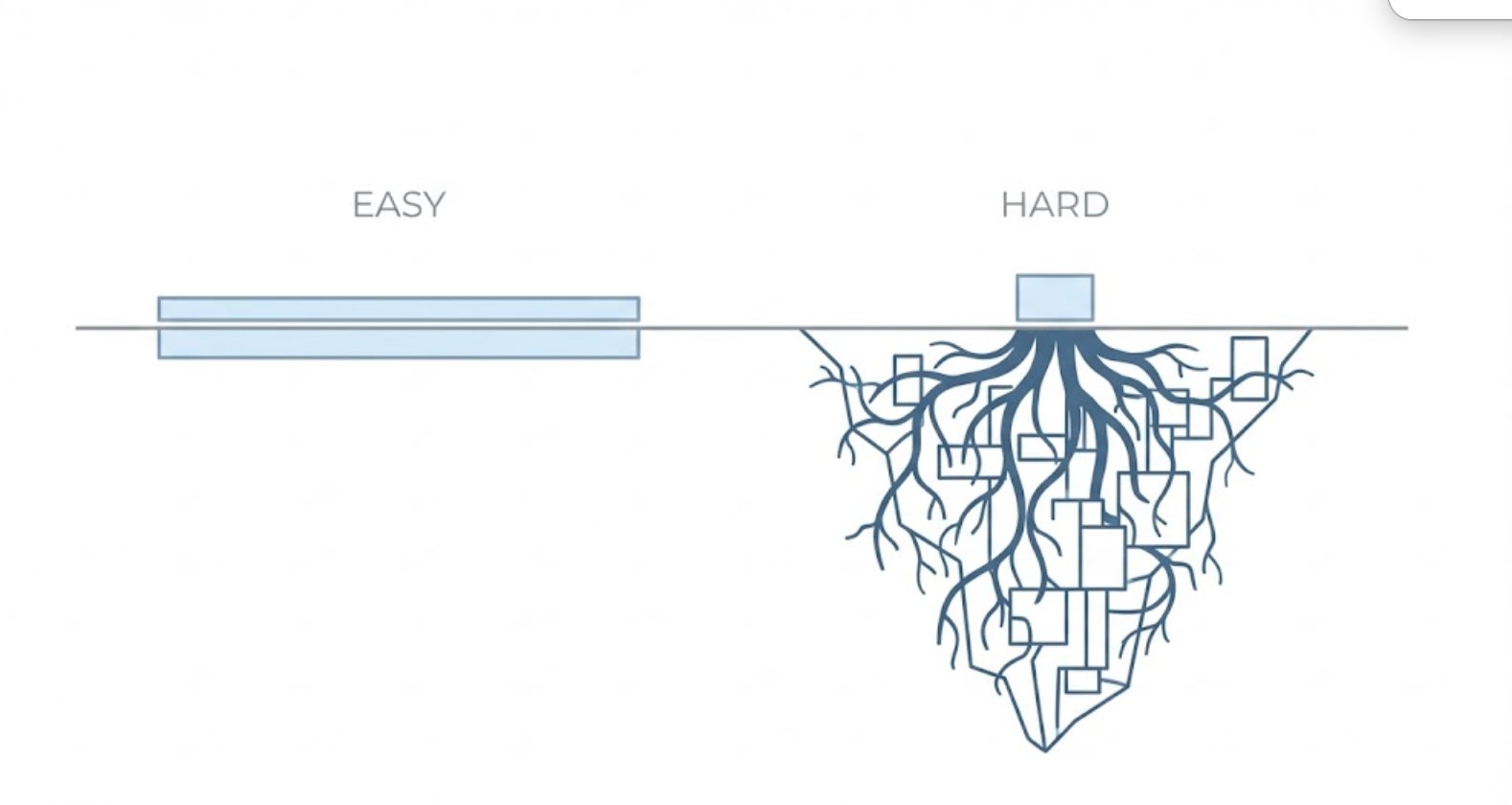
Most founders chase the easy product. The one that's simple to explain, fast to build, and feels like a quick win. But the easy product is usually easy for everyone — including your competitors.


Most founders chase the easy product. The one that's simple to explain, fast to build, and feels like a quick win. But the easy product is usually easy for everyone — including your competitors.
The hard product is different. It's hard to build, hard to copy, and hard to replace once it's embedded in how someone works.
Here's the distinction I've come to rely on:
- Easy product — solves a surface-level problem, low switching cost, commoditizes quickly
- Hard product — solves a structural problem, creates dependency through value (not lock-in tricks), takes real time and craft to get right
At MOP, we have experienced this many times, especially while building complex Fintech platforms. Specific knowledge and deep business logic, real-time systems, complex deployments. We often built deep into the operational layer.
It took longer. It was messier. But five years in, nobody could just copy-paste their way to competing with us. There is no way to vibe-code them over a weekend.
The best products are hard to build and hard to leave. That's not a coincidence — it's the strategy.
The easy product is tempting because it gives you early traction. But early traction on an easy product is a trap. You grow, then a better-funded team builds the same thing in six months and undercuts you on price.
The hard product earns its defensibility. Not through patents or legal moats, but through depth. The more a customer uses it, the more it understands their context, their data, their workflow. That's compounding value — and it's nearly impossible to replicate from the outside.
One honest caveat: hard doesn't mean complicated. The best hard products feel simple to the user. The complexity lives in the engineering, the data model, the edge cases you've already solved. What the user sees is a clean surface. What's underneath is years of work.
Choose the hard product on purpose. Not because you enjoy suffering, but because it's the only kind that builds something worth having.
The Productivity Trap
The backlog is empty. The roadmap is done. Features are shipping every week. And nobody wants the product.
That's the trap. Everything felt productive. The AI wrote the specs, generated the user stories, filled the Notion pages with plausible-sounding strategy. The work got done. It just wasn't the right work.
AI makes the easy things effortless. That's genuinely useful. But it also makes the hard things easier to skip — and the hard things are still the job. Talking to customers is hard. Saying no to a feature request is hard. Killing something you've already built is hard. No language model does that for you. No prompt gets you out of the room with a user who tells you your core assumption was wrong.
The problem was never that product work was too slow. It was that the hard parts — the parts requiring judgment, taste, and direct contact with reality — kept getting deferred. AI just made deferral faster.
I've recently watched founders ship for three months without a single real customer conversation. Not because they were lazy. Because they were busy. The AI gave them an endless supply of things to do that felt like progress: personas, positioning docs, competitive analyses, sprint plans. All of it coherent. None of it grounded in whether an actual human being wanted what they were building.
That's the new failure mode. Not moving too slow. Moving fast in the wrong direction, with a very clean Confluence page to show for it.
The New Shape of Easy
AI hasn't made building harder. It's made building effortless. And that's the problem.
You can now clear a backlog, generate a feature spec, and ship working code in the time it used to take to schedule a planning meeting. The marginal cost of "one more thing" is approaching zero. Need a new onboarding flow? Ask. Need 20 user stories? Done. Want to build it solo without syncing with anyone? The AI is always available, always agreeable, never pushes back.
This feels like progress. It is not.
37signals said it years ago: every feature is a liability, not an asset. Every line of code is debt. Every addition to the product is something you'll maintain, explain, support, and eventually regret. The discipline was always in what you didn't build. With AI, you can now accumulate liabilities at 10x the speed, with a fraction of the friction that used to slow you down.
That friction wasn't a bug. It was a filter.
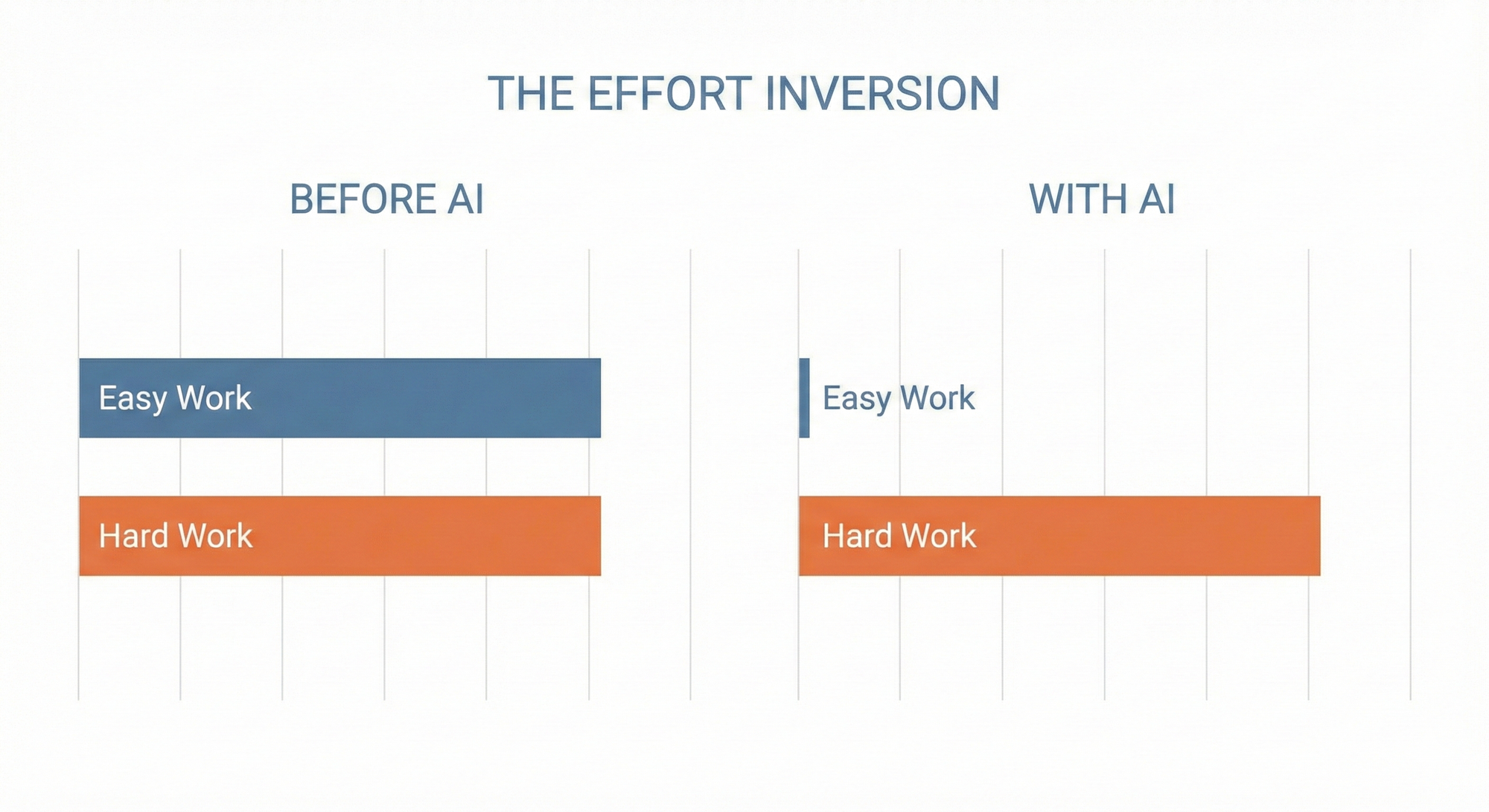
The Effort Inversion: AI inverts the cost structure of building. The hard things — thinking clearly, validating assumptions, talking to users, making real tradeoffs — cost the same as they always did. The easy things — writing code, generating copy, producing tickets — now cost almost nothing. When effort is cheap, we default to it.
Speed used to be the constraint. Now it isn't. Which means the bottleneck has shifted entirely to judgment — and judgment doesn't get faster just because your tools do.
What Got Hard (And Why That's the Point)
AI makes the easy things easier. That's not an insult — it's a warning. Because the easy things were never what separated good products from failed ones.
Easy with AI: Drafting specs. Writing copy. Generating user stories. Summarizing research. Building prototypes. Producing in a day what used to take a week.
Hard with AI — and harder now that you have an excuse to skip it:
- Original thinking. It's effortless to let the AI's framing become your framing. You stop questioning the premise. You start refining the answer it gave you instead of finding a better question. The output looks sharp. The thinking underneath it is borrowed.
- Real user research. AI can synthesize what's already been written. It cannot sit across from a frustrated customer and hear what they're not saying. It can't feel the silence after you ask "would you pay for this?"
- Selling. The discomfort of pitching, of hearing "no," of watching someone struggle with your product — that's irreplaceable signal. AI makes it easy to skip this entirely. So most people do.
- Real collaboration. Async, solo, AI-assisted work feels efficient. But the friction of an actual whiteboard session — where someone pushes back on your assumption and you have to defend or abandon it — is where strategy actually forms.
I've watched a team use AI to "validate" an idea. They asked it whether the market existed. It said yes. It always says yes. They built for six months. The market didn't exist. Two weeks of customer calls would have told them that. Instead they got six months of confident, AI-assisted misdirection.
AI is agreeable. It will help you build whatever you want to build. That's not a collaborator — that's a yes-man with a compiler.
The hard things are hard for a reason. That friction is information.
The Clutter Trap
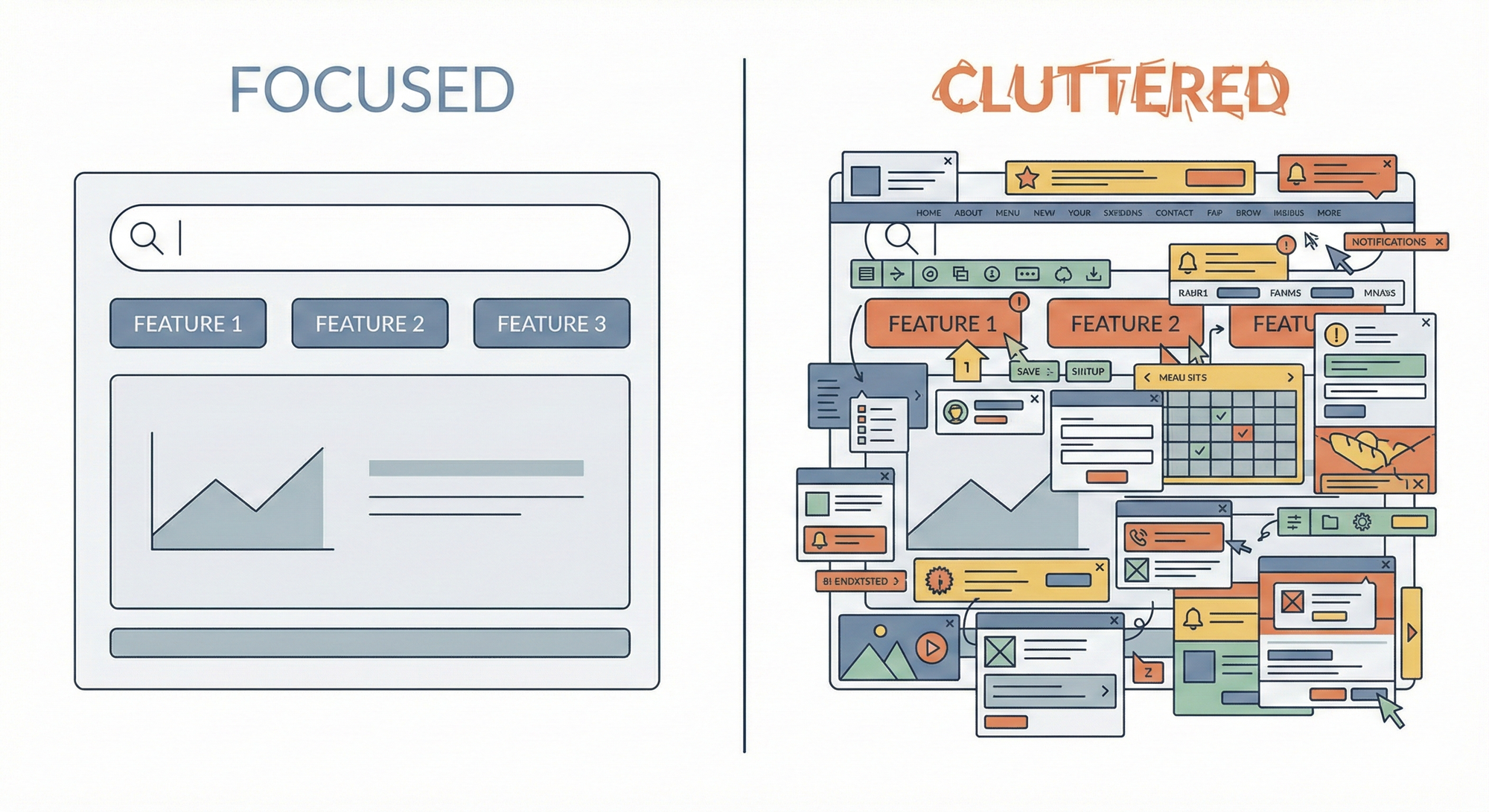
Feature bloat has always killed products. AI just removed the last thing slowing it down.
The old constraint was friction. Adding a feature used to cost you engineering time, design time, QA cycles, and a product review where someone had to stand up and justify the thing. That friction wasn't just bureaucracy — it was a filter. Bad ideas died because they were expensive. The cost of building was a forcing function for thinking.
That forcing function is gone.
With AI-assisted development, the marginal cost of adding a feature is approaching zero. Which means every half-formed idea in a backlog can ship. The product becomes a junk drawer — technically functional, practically unusable.
The math on complexity hasn't changed. Only the speed at which you can rack up the debt has.
Every feature you add that 10% of users need costs the other 90% something. Attention. Confusion. Slower load times. A harder onboarding. A support doc that now needs updating. A new edge case in the codebase. These costs don't show up in your sprint velocity. They show up six months later when your activation rate drops and nobody can figure out why.
One product team I know did a feature audit and found that 40% of their features had fewer than 5% monthly active users. Built, documented, and maintained for years. Nobody used them. Removing them felt terrifying — because someone had asked for them once.
Basecamp has kept its feature set deliberately constrained for over 20 years. Not because they couldn't build more. Because they understood that reduction is a product skill — arguably the hardest one. It requires judgment. Taste. A real understanding of what your best users actually do versus what they say they want in a survey.
AI doesn't have taste. It can generate options endlessly. It cannot tell you what to cut.
Do the Hard Stuff
The competitive advantage in an AI world isn't who ships the most. It's who thinks the clearest, validates the hardest, and reduces the most ruthlessly.
Anyone can fill a backlog. AI will happily help you do it faster than ever. The real job — the one that still requires a human — is deciding what shouldn't exist.
Here's what that actually looks like:
- Think before you build. Use AI to explore the problem space, but own the conclusion. I've caught myself three times in the last month about to accept a framing that Claude gave me — and each time, sitting with it for ten more minutes revealed a different problem entirely. The model doesn't know your users. You do.
- Validate with real humans. No synthetic research. No AI-generated personas. Sit on the call where the customer says "I don't really get it" and resist the urge to explain. That discomfort is data.
- Reduce before you add. Before the next sprint, ask: what would we cut if we had to ship 20% less? If you can't cut anything, your prioritization isn't working — you've committed to everything, which means you've committed to nothing.
- Collaborate with friction. Pull people into decisions — not for consensus, but for challenge. A ten-minute argument with a skeptical engineer has saved me from more bad decisions than any discovery process I've ever run.
The builders who win aren't the ones with the best AI tools. They're the ones who know where AI stops and judgment begins.
Last quarter I was deep in a new feature direction. Spec half-written, tickets drafted. The work felt done. But I hadn't talked to a single user. I'd talked to a language model. I killed the spec, booked five customer calls, and found out the problem I was solving ranked seventh on their list of frustrations. Seventh.
That's the hard stuff. Slower, messier, less satisfying than shipping. Also the only thing that actually matters.
Want to turn insights into shipped products?
Start you product journey with us.
The Real Leverage
AI is a multiplier. The question is what you're multiplying.
Point it at shallow work — writing PRDs nobody reads, generating roadmaps nobody follows, producing copy for products nobody wants — and you'll just move faster toward the wrong destination. Speed isn't the constraint for most failing products. Clarity is. Direction is.
The builders who win in an AI world won't be the ones who automated the most. They'll be the ones who stayed human where it counted — in the argument about what to cut, in the honest conversation with a customer about to churn, in the decision to kill a feature that took three months to ship. Those moments don't compress. They don't prompt well. They require judgment built from experience.
Use AI to write the boilerplate, generate the test cases, draft the first pass, summarize the transcript. That's real leverage — it buys you time to do the work that actually matters. But don't confuse the time it saves with the thinking it replaces. It doesn't replace the thinking. It never did.
AI will write the code. You still have to figure out if it's worth writing.